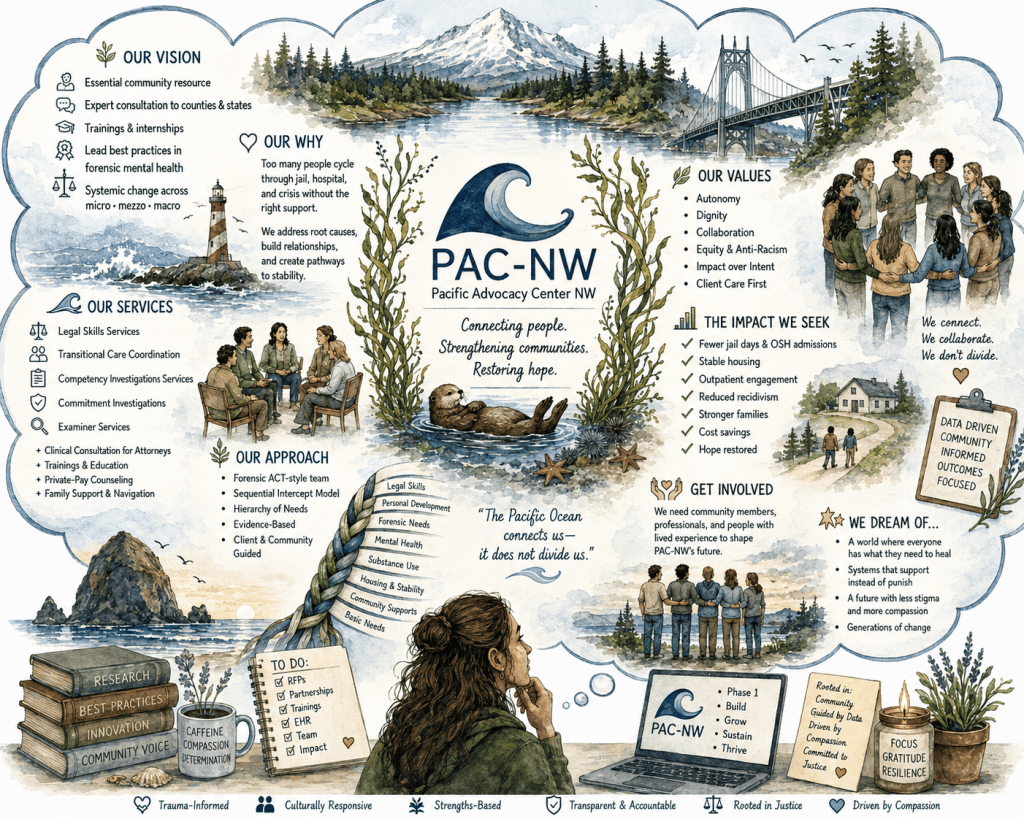
Early in my career I worked for a non-profit in Honolulu where attorneys, advocates, case managers, counselors all worked within the same agency supporting their clients on the same team. This is my dream for competency restoration. And this model is where my dream for PAC-NW is inspired from.
Over the years I have observed adversarial relationships develop between stakeholders who are working together to support the same clients. I have noted referrals to care not being followed up on. Agencies not returning calls, emails or outreach attempts by clients, families and colleagues. If lack of continuity, communication, collaboration, and shared mission are interfering with client outcomes then we as the professionals need to be on the same page.
My long term dream for PAC-NW is to become a forensic mental health agency known for providing all the services our competency population needs under one roof. I draw inspiration from established frameworks including the Sequential Intercept Model, Forensic Assertive Community Treatment (FACT), Maslow’s Hierarchy of Needs, Risk-Need-Responsivity (RNR), and other evidence-informed behavioral health and forensic interventions.
These frameworks will guide an integrated, person-centered care that addresses basic stability, clinical treatment, and recovery to legal-system navigation, competency-related support, community integration, and long-term independence.
I want…
a Defendant to come in through our doors and meet with their Defense Attorney and Mental Health Clinician for their intake.
an assessment, treatment plan and referrals completed before an initial fitness motion and hearing.
wraparound supports in place before the forensic evaluation.
neurocogntivie and neurodevelopmental issues identified, assessed, and referred out with the appropriate ongoing support.
in house coordinators to be tracking referrals, outcomes and following up with DHS, APD, DD, VA, Housing Services regularly.
our Defendants to stay with our clinical team after their cases are resolved and not have to be discharged from services just because competency has concluded.

Over the next two years I will be spending my time with my competency community. You will see me at court, I will be asking questions, I will be tracking cases I know to be high recidivism clients in my jurisdiction. I will be consulting with other counties to see what they’re missing. I will be researching therapeutic modalities, consulting with legislators and following the next legislative session.
All of this to make this dream become a reality.
I want to hear from you because I cannot do this without my community.
 PAC-NW